
When you invest in a new garage door, you probably expect the whole system to just show up ready to go. But in practice, what actually arrives on installation day depends on the model you choose, how your local distributor structures the quote, and whether you asked the right questions before signing. This guide breaks down exactly what comes standard with modern Overhead Door residential garage door openers, which popular features are actually add-on accessories, and how to make sure you get the right garage door operators and accessories for your home.
Key Takeaways
- Overhead Door residential garage door openers typically ship as a complete operator kit that includes a motor unit, rail assembly, trolley, wall control, at least one remote, Safe-T-Beam® safety sensors, and basic lighting. Many popular features like wireless keypads, extra remotes, smart controls, and battery backup are considered accessories and may need to be ordered separately.
- The exact package contents depend on the specific Overhead Door model you select, the authorized distributor handling your installation, and whether the door is sold as a bundled system or as an à la carte operator plus accessories. Always confirm line-item details before purchase.
- The most common upgrades homeowners choose at installation include a wireless keypad for PIN-based entry, additional CodeDodger® remotes for extra drivers, the OHD Anywhere® smart control kit for smartphone monitoring, and a battery backup unit for power outages.
- Built-in safety and security features like Safe-T-Beam® photoelectric sensors, automatic reversal systems, and rolling-code technology are standard on modern residential garage door operators, not optional add-ons. Safety sensors detect obstructions and prevent the door from closing to avoid accidents.
- Before signing a quote, ask your authorized Overhead Door distributor for a written breakdown of every included component and accessory so you know exactly what you are paying for and can identify any upgrades worth adding on installation day.
What You Get With a Standard Overhead Door Residential Garage Door Opener
First, a clarification that trips up a lot of homeowners: your garage door and your garage door opener are two separate things. The door itself consists of the physical panels, tracks, springs, rollers, and cables. The garage door operator is the powered mechanism-motor head, rail, trolley, and electronics-that automates the opening and closing. When you buy a new door from an Overhead Door distributor, an opener may or may not be part of the quote. Some installers bundle the operator with a new overhead door purchase, while others list them as separate line items. Always check.
That said, when you do purchase a modern Overhead Door residential garage door opener, it typically arrives as a complete kit designed to get your system operational. Here is what usually ships in the box:
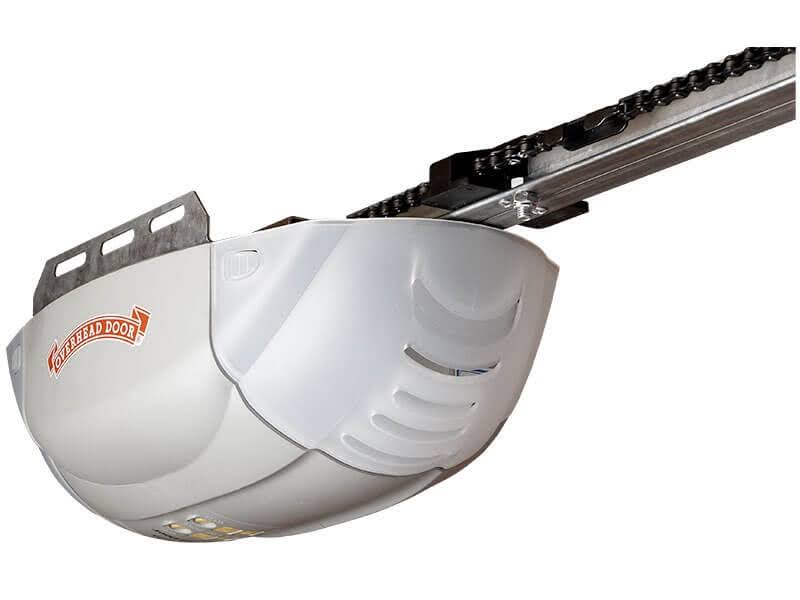
- Motor head (powerhead): The main driving unit. Many current Overhead Door models use DC motors, which are quieter and smoother than AC motors. AC motors are typically louder and heavier than DC motors, which is why the industry has shifted toward DC technology for residential use.
- Rail assembly: The track that spans from the motor head to above the door. This comes as a chain-drive, belt-drive, or screw-drive configuration, depending on the model. The primary types of garage door operators are chain-drive, belt-drive, screw-drive, and wall-mount. Wall-mount operators save ceiling space and reduce noise transmission, making them an option worth discussing with your installer if headroom is tight.
- Trolley and door arm: The trolley rides along the rail and connects to the door via a curved or straight door arm. An emergency release cord and handle are also included, allowing you to manually disconnect the trolley and operate the door by hand if needed.
- Mounting hardware: Brackets, angles, hanging straps, screws, bolts, and wire clips. Some kits include rail extenders for high ceilings or unusual rafter configurations.
- Light socket or integrated LED lighting: Standard units include at least a light bulb socket with a specified maximum wattage. Some newer models feature integrated LED lighting modules that eliminate the need for replaceable bulbs entirely.
- Wall control: Most current Overhead Door openers include at least one wired wall console or push-button. Many models ship with a multi-function Series II wired wall console that provides open/close control, independent light operation, and a Sure-Lock™ vacation lock feature to disable remotes and keypads when you are away.
- Remote transmitter(s): At least one CodeDodger® remote is typically included, often a three-button transmitter that works on dual-frequency (315/390 MHz) for better signal reliability. The exact count of remotes can vary by model and current promotions.
- Safe-T-Beam® photoelectric safety sensors: These are two infrared sensors that mount near the floor on either side of your garage door opening. If anything breaks the beam while the door is closing, the system stops and reverses the door. This is not optional-it is required by UL 325 and ANSI safety standards for all residential garage door openers sold in the United States.
Overhead Door offers different motor and drive types as core components of the opener package, not as accessories. Whether you choose a quiet belt-driven system, a durable chain-drive unit, or a direct-drive/screw technology depends on your priorities for noise, maintenance, and budget. These are decisions you make when selecting the opener model itself.
Common Accessories and Upgrades for Your New Garage Door Operator
Many of the features homeowners expect to find in the box with their new garage door openers-wireless entry, extra remotes, smartphone control-are actually considered accessories. They may or may not be included unless you specifically request them or select a higher-tier model. Here is what is available and when each upgrade makes sense.
- Additional remote transmitters: Overhead Door offers single-button, two-button, and three-button CodeDodger® transmitters in a variety of form factors, including visor-clip remotes and compact key-ring styles. If you have multiple drivers in your household or want a spare, purchasing extra remotes at installation is the easiest time to do it. These remotes are compatible with HomeLink® and Car2U® in-vehicle systems, so you may not even need a standalone remote for every car.
- Wireless keypads: One of the most requested add-ons at installation. Wireless keypads enable secure PIN-based entry to garage doors, making them ideal for kids who walk home from school, dog walkers, or anyone who needs access without a remote. Most Overhead Door keypads can control up to three residential garage door openers from a single unit, feature back-lit buttons, and come with a flip-up cover for weather protection. A universal wireless keypad works with most major brands, but for seamless integration, using an Overhead Door model is recommended.
- Interior wall console upgrades: Beyond the basic push-button, upgraded consoles offer larger backlit controls, motion-activated lighting, and the Sure-Lock™ feature that lets you lock out all external remotes and keypads with a single switch. Wireless wall consoles allow for easy installation without wiring, which is a convenience if you want to add a second control point in a different location inside your garage without running new cable.
- OHD Anywhere® smart control: This is Overhead Door’s app-enabled smart device integration for your garage. Smart Wi-Fi modules allow remote door monitoring and control, so you can open, close, and monitor your overhead door from a smartphone, receive real-time alerts when the door moves, grant permission to other users through virtual keys, and check door history logs. Smart garage door openers can be controlled via mobile apps on both iOS and Android. The system supports up to 20 doors across multiple modules, and each module can handle up to three operators. Smart garage door openers allow remote monitoring via mobile devices, which means you can check whether your garage is actually closed while sitting at your desk across town.
- Battery backup: A battery backup unit connects directly to the opener and allows the operator to function during a power outage, delivering up to approximately 50 open/close cycles within a 24-hour period, at a slightly reduced speed of about 3.5 inches per second. This is increasingly recommended in regions affected by storms, wildfire-related utility shutoffs, or local building codes. California law requires battery backup for installed garage door openers under SB 969, so if you live in California, this is not optional. Some Overhead Door models, like the Legacy 850 “B” series, include battery backup as standard.
- Upgraded lighting: If your opener uses a standard light bulb socket, follow the wattage printed on the housing, commonly 60W for incandescent. Garage door opener LED bulbs avoid remote interference, which is why purpose-built LED bulbs designed for garage door openers are strongly recommended over regular household LEDs. Some newer Overhead Door products feature integrated LED lighting modules that deliver better brightness, orientation toward the garage interior, and automatic on/off behavior without any bulb changes.
- Laser parking guides: These accessories project a beam onto your dashboard or garage floor to assist with parking accuracy in garages, eliminating the guesswork of pulling in far enough without bumping the back wall.
- Additional safety and security accessories: For multi-door garages, you may need additional Safe-T-Beam® sensor sets. Monitored sensing edges are available for specialty residential applications where standard photo-eyes do not provide sufficient coverage. Surge protectors prevent damage to garage door opener electronics, which is a worthwhile addition in areas prone to electrical storms. Automatic deadbolt locks engage whenever the door closes to enhance security, adding a physical locking layer beyond the electronic controls.
- Specialty adapter kits: Certain accessories, like the Torque Master Adapter Kit, are designed for Genie wall mount openers and other specific configurations. If you are working with non-standard hardware, ask your installer about compatibility before purchasing.

Choosing the Right Residential Garage Door Operator Package for Your Home
Overhead Door’s network of authorized dealers helps customers select the right residential garage door opener package based on real-world factors: how much sound you can tolerate, how much power your door requires, which features matter to your daily routine, and which accessories bring genuine convenience versus nice-to-have extras. The choice of garage door operator depends on door weight, layout, and desired features, so a conversation with a knowledgeable distributor is worth more than any online spec sheet.
Top garage door operators include quiet models with integrated smart technology, but not everyone needs the flagship option. Here is how to think through the decision:
- Drive type matters more than you think. Belt drive garage door openers are the quietest available, making them the right call if your garage shares a wall with a bedroom or living space. Chain drive openers are durable with routine maintenance and typically cost less, but they produce more sound during operation. Screw drive openers provide the fastest operating speeds for large doors and require relatively little maintenance. Wall-mount units eliminate the ceiling-mounted rail entirely, freeing up overhead storage space. Your choice should reflect both your garage layout and your tolerance for noise at 6 AM.
- Door weight and construction shape the decision. A lightweight, non-insulated steel sectional door requires less lifting force than a heavy insulated steel overhead door, a carriage-style door, or a solid wood panel. Heavier doors may require more powerful operators classified as “HPc Power Plus” by Overhead Door, which exceed the lifting capacity of standard ½ horsepower units. Ceiling height and headroom also affect rail length and mounting options.
- Good, better, best-in practice. A basic Overhead Door operator package gives you a standard motor, one remote, a wall push-button, Safe-T-Beam sensors, and a light socket. A mid-range setup adds a wireless keypad, a multi-function wall console with Sure-Lock, an extra remote, and improved lighting. A premium configuration includes full OHD Anywhere® smart integration, battery backup, integrated LED lighting, a quieter belt or direct-drive motor, and multiple remotes, setting a new standard for what a home garage system can do. Garage door operators can be customized with various features according to user needs, so you are not locked into a rigid tier structure.
- Compatibility with your existing setup. Current Overhead Door openers are designed to integrate with popular in-vehicle systems like HomeLink® and Car2U®. If your garage door hardware is in good condition-tracks aligned, springs properly tensioned, panels undamaged-a new operator can often be installed on the existing door. But if the door itself is aging, replacing everything together usually delivers better long-term performance and a cleaner warranty picture.
- Security is built in, but layers help. Rolling-code technology in modern Overhead Door CodeDodger® transmitters means the access code changes with every use, making signal interception essentially useless. The Sure-Lock feature on wall consoles lets you disable all external remotes and keypads with a single switch when you leave for vacation. And OHD Anywhere® lets you monitor whether the door is actually closed from anywhere with a data connection-a level of secure, real-time awareness that older systems simply cannot match.
- Ask for the full written breakdown. Before signing any quote, request a line-item list from your local Overhead Door distributor that spells out the opener model, number of remotes, keypad inclusion, light bulbs or LED modules, safety sensors, labor costs, and warranty specifics. This eliminates surprises on installation day and ensures you can make an informed decision about which accessories to add now versus later.
Installation, Maintenance, and What to Expect Long After Day One
Professional installation by an authorized Overhead Door distributor ensures your new residential garage door opener and all accessories are wired, aligned, and tested for safety from day one. This is not a shortcut-friendly process; proper installation directly affects how long your system lasts, how quietly it runs, and how reliably it keeps your home secure.
- What happens on installation day? The installer removes any existing garage door operator, mounts the new motor head and rail assembly to the ceiling and header bracket, installs and levels the Safe-T-Beam® sensors, wires the wall control, pairs all remotes and keypads, and configures the opener’s travel limits and force settings. The emergency release is connected and tested. The installer then verifies automatic reversal using both the contact method (placing a 2×4 flat on the floor under the door) and the non-contact photo-eye system. All moving parts are checked, and the door’s balance and spring tension are confirmed.
- Smart accessory setup. If you have opted for OHD Anywhere®, the installer connects the module to your home Wi-Fi network during the visit. This involves mounting the module, connecting to its temporary setup network, configuring through the mobile app, installing the door position sensor on the top panel, and creating your user account. From there, you can set schedules, enable alerts, and grant guest access to family members-all from your phone.
- Routine homeowner maintenance. Test the Safe-T-Beam® system monthly by waving an object through the beam while the door is closing-it should reverse immediately. Run the 2×4 reversal test periodically as a reference check on the contact reverse system. Keep the photo-eye lenses clean and free of cobwebs or misalignment. Replace the opener light bulb when it burns out, following the wattage and type specified in your owner’s manual. If your opener uses integrated LED lighting, check for any status indicators that signal a module issue. LED bulbs designed for garage door openers reduce remote interference, so always use purpose-built bulbs rather than standard household LEDs.
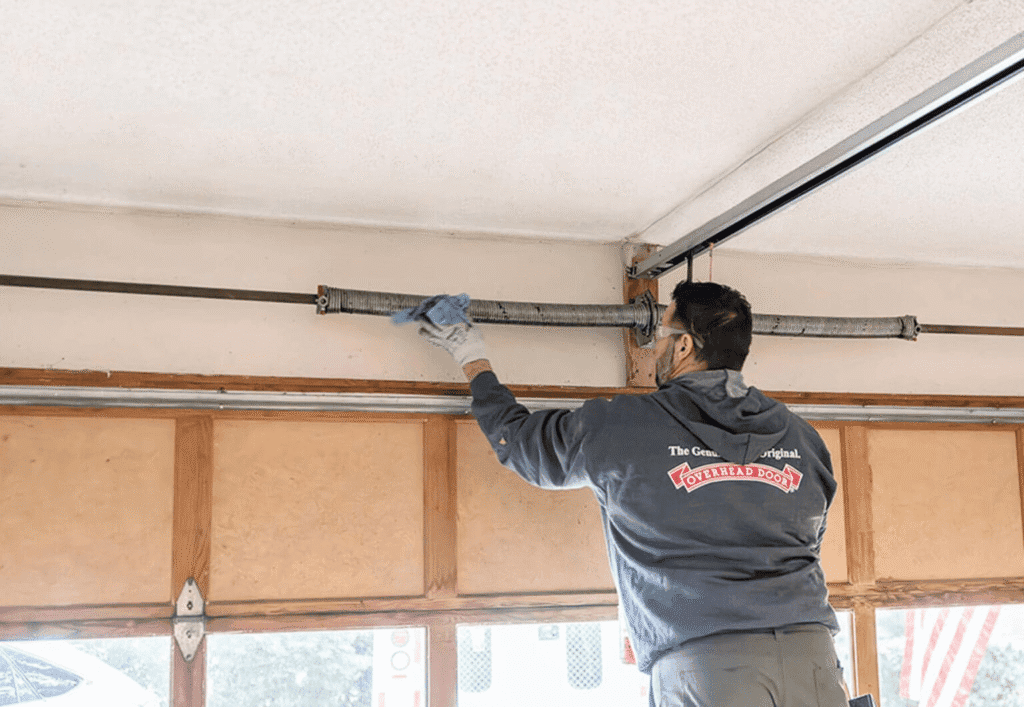
- The door needs attention, too. Your garage door itself requires periodic professional service: spring and cable inspections, track alignment checks, roller and hinge replacement as they wear, and hardware lubrication per manufacturer recommendations. Overhead Door distributors can service both the door and the operator together during a single visit, which is the easiest way to keep the full system in high working order.
- How long accessories last and when to upgrade. Remotes and wireless keypads typically need battery replacement (usually CR2032 or similar) every few years. Smart modules like OHD Anywhere® receive firmware updates that can extend features over time. Safety sensors generally remain in place for the life of the opener unless physically damaged. Signs that it may be time for a full opener upgrade include excessive noise during operation, frequent mechanical failures, slow or inconsistent travel speed, or the inability to integrate with modern smart controls. If your current operator lacks rolling-code security or modern reversing systems, replacement is not just a convenience upgrade-it is a safety improvement.
- Keep your paperwork. Store your Overhead Door warranty documentation, installer contact information, and model numbers in an easy-to-find location. Knowing exactly who to call if any part of your garage door operator system or accessories needs service or expansion later saves time and ensures warranty-covered repairs are handled correctly.
As an aside worth noting: many homeowners are increasingly conscious of the environmental footprint of every product they bring into their home. Across industries, sustainability-focused businesses prefer packaging that is certified compostable and recyclable. FSC-certified papers support sustainable forestry practices, while eco-friendly packaging utilizes biodegradable materials to reduce plastic use. Vegetable-based inks are used in eco-friendly packaging to minimize environmental impact. Innovative design services enhance brand identity through custom packaging. While garage door operators are built for decades of use and durability rather than disposability, asking your distributor about responsible disposal of old equipment and recycling of packaging materials is a reasonable step in the right direction.

Frequently Asked Questions About Garage Door Operators and Accessories
Below are answers to the most common questions homeowners ask about what is and is not included with new garage door operators and how accessories work within the Overhead Door ecosystem. Each answer covers scenarios and edge cases that go beyond the main sections above.
Do I automatically get a new garage door opener when I buy a new garage door?
Not necessarily. A new overhead door purchase from an Overhead Door distributor does not always include a new residential garage door opener by default. Some quotes list only the door panels, tracks, springs, hardware, and installation labor. Others bundle a specific operator and accessories into a single package price. The difference depends entirely on how your local distributor structures the proposal. Before signing anything, ask to see every line item so you know whether the operator, remotes, keypad, sensors, and labor are all accounted for. If the quote only covers the door, you will need to add the opener as a separate purchase, and that is the perfect time to decide which accessories to include from the start.
Can I reuse my existing remotes and keypad with a new Overhead Door operator?
It depends on how old your current accessories are. Older remotes or keypads using different radio frequencies or outdated security protocols may not be compatible with current CodeDodger® residential garage door openers, which use rolling-code technology on dual-frequency 315/390 MHz signals. In many cases, the installer will provide new remotes as part of the opener kit and can advise whether any of your existing accessories can be safely reprogrammed. If your remotes are more than ten years old or use a fixed-code system, replacement is the safer and more secure route. Documentation hosted on Overhead Door’s EdgeSuite content servers and product reference guides can help identify specific model compatibility if you want to check before installation day.
What type of light bulb should I use in my garage door opener?
Always follow the wattage and lamp type printed on your opener housing or listed in the Overhead Door owner’s manual. Most standard openers accept incandescent bulbs up to 60W or 100W, depending on the model, but using LED bulbs specifically designed for garage door openers is strongly recommended. These specialty LEDs are built to handle vibration, resist shattering, and-critically-avoid the radio frequency interference that standard LED bulbs can cause with remote transmitters and wireless keypads. If your model features integrated LED lighting, no bulb replacement is needed, and brightness is managed by the built-in module. Never exceed the maximum wattage rating, as doing so creates a fire risk and may void your warranty.
Will my garage door opener work if the power goes out?
Standard residential garage door openers will not run without electrical power. However, every Overhead Door opener includes an emergency release handle that allows you to disconnect the trolley from the rail and operate the door manually. If you want powered operation during outages, adding a compatible battery backup accessory solves the problem. Overhead Door’s battery backup units connect directly to the opener and can deliver approximately 50 open/close cycles within a 24-hour period at a reduced speed. Battery backup systems are now required in California for garage door openers under state law SB 969, meaning any opener installed or replaced in California must include this feature. Even outside California, a battery backup is a practical investment for ease of use during storms or planned utility shutoffs.
Can I add smartphone control to an older Overhead Door residential opener?
Many existing Overhead Door garage door operators manufactured after 1993 can be upgraded with an OHD Anywhere® smart control kit, provided they have functioning photoelectric safety sensors in place. The retrofit kit includes a Wi-Fi module, a door position sensor, and everything needed to connect your existing opener to the OHD Anywhere app. Once installed, you can open, close, and monitor your door from any smart device with internet access, set schedules, and receive real-time alerts. Before purchasing the accessory, check your opener’s model number against the compatibility list on the Overhead Door website, or contact your local Overhead Door distributor to confirm. If your garage does not have Wi-Fi coverage, you may need to extend your home network with a range extender or access point before the smart module can function reliably.
Your garage is one of the most-used entry points in your home, and the right combination of operator and accessories makes every arrival and departure easier, safer, and more secure. Now that you know what ships in the box, what counts as an upgrade, and which questions to ask, you are ready to have a productive conversation with your local Overhead Door distributor. Find a distributor near you, request a detailed quote with every component listed, and build the system that fits your life, not just your garage.